

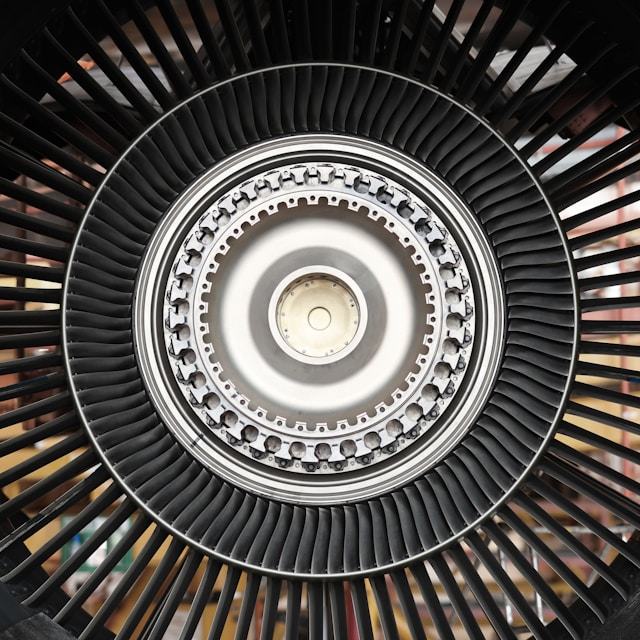
Gas turbines don't fail gracefully. A worn bearing, a fouled compressor stage, or a drifting temperature sensor can look like normal noise for weeks — right up until it isn't. In power generation and aviation alike, the gap between "early warning" and "unplanned shutdown" is measured in the quality of the diagnostic system watching the machine, not in the machine itself.
This is the core problem ISACLAB works on: building systems that catch gas turbine faults early, explain what's actually wrong, and — increasingly — predict how much life the component has left.
Why Gas Turbines Are Hard to Diagnose
Unlike a lot of industrial equipment, gas turbines rarely fail in one clean way. A few things make the problem genuinely hard:
- Strong nonlinearity. Turbine thermodynamics change shape across the operating envelope, so a model tuned for steady-state load can miss faults that only show up during startup, shutdown, or load transients.
- Multiple, overlapping fault modes. Compressor fouling, bearing wear, blade erosion, and sensor faults can produce similar symptoms in the exhaust temperature or vibration spectrum, making isolation — not just detection — the hard part.
- Sensor noise and drift. A diagnostic system that can't tell a faulty sensor from a faulty component will chase ghosts.
- Safety-critical margins. False alarms are expensive to investigate; missed detections can be catastrophic. The threshold between the two has to be set carefully, not guessed at.
Physics First, Then Learning
ISACLAB's approach typically starts with a physics-based or semi-physical model of the turbine — not a black box. Dr. Ali Chaibakhsh and collaborators built a transient simulation model for heavy-duty gas turbines (Applied Thermal Engineering, 2018) that captures startup and load-change dynamics realistic enough to serve as the backbone for later fault-detection work.
From there, the lab has developed nonlinear input-output models — including a series-parallel NARX model for fault detection and isolation (ISA Transactions, 2021) — and adaptive-threshold methods such as a Monte Carlo-based approach for robust fault diagnosis (ISA Transactions, 2020) that sets detection thresholds based on the actual uncertainty in the system rather than a fixed rule of thumb. The idea in both cases is the same: let the physics carry as much of the diagnostic burden as it reliably can, and reserve machine learning for what physics alone can't resolve.
Where Machine Learning Takes Over
Once a residual — the gap between what the model expects and what the sensors report — is generated, the harder question is which fault it points to and how confident the diagnosis is. This is where ISACLAB leans on data-driven methods:
- A new fault diagnosis approach for heavy-duty gas turbines, published in IEEE/ASME Transactions on Mechatronics (2022), pairs data-driven fault isolation with the lab's process models.
- A nonlinear intelligent observer combined with a Takagi–Sugeno fuzzy inference system improves fault isolation robustness under sensor anomalies (IEEE Sensors Journal, 2023).
- More recent work explores nonlinear feedforward filters combined with deep learning for gas turbine diagnosis (2025 IEEE CCECE), continuing the lab's push toward deep architectures for rotating machinery generally, including multi-scale CNNs for bearing fault diagnosis under sensor anomalies.
From "What's Wrong" to "How Long Do We Have"
Detecting a fault is only half the problem for an operator — the other half is deciding whether to run the asset to the next scheduled outage or shut it down now. ISACLAB's prognostics work targets exactly that gap: a compressor failure prognostic method using nonlinear observers and a Bayesian algorithm for heavy-duty gas turbines (IEEE Sensors Journal, 2023) estimates remaining useful life rather than just flagging a binary fault/no-fault state — the difference between a diagnostic system and a genuine decision-support tool.
Digital Twins: Watching the Engine Think Ahead
The lab's most recent turbine work pushes this further into a full dynamic, physics-based digital twin for supervisory control, condition monitoring, and fault diagnosis of industrial turboshaft engines (Digital Twin, 2025). Instead of a single diagnostic model bolted onto the real turbine, a digital twin runs a continuously updated virtual copy alongside it — so operators can simulate "what happens if we keep running at this load" before committing to it on the real machine.
Fault Detection Doesn't Stop at Mechanical Faults
The same residual-generation logic that catches a fouled compressor also catches something more adversarial: a cyberattack on the turbine's control loop. ISACLAB has extended its fault-detection framework to cyberattack and anomaly detection in the presence of actuator lags and communication delays, applied specifically to industrial gas turbines (IEEE Transactions on Industrial Cyber-Physical Systems, 2024) — treating a spoofed sensor reading and a genuine sensor fault as two instances of the same underlying isolation problem.
The ISACLAB Toolbox at a Glance
Across these projects, a few methodological threads keep reappearing:
- Nonlinear process models (NARX, neuro-fuzzy, thermodynamic simulation) as the physics backbone
- Adaptive and statistically-grounded thresholds instead of fixed alarm limits
- Deep learning and ensemble methods for isolation under sensor noise and anomalies
- Bayesian and observer-based prognostics for remaining-useful-life estimation
- Digital twins for supervisory decision support
- Unified fault/anomaly detection that treats faults and cyberattacks under one framework
Where This Is Headed
Gas turbine diagnostics is converging with two other things ISACLAB works on: robust and networked control system design, and condition monitoring, prognostics, and digital twins more broadly across rotating machinery and power plants. The direction is toward diagnostic systems that don't just alarm — they explain, quantify remaining life, and hand the operator (or the control system itself) a decision, not just a number.
If you want to dig into the source material, the full list of the lab's publications on fault detection and diagnosis is public, and you can find Dr. Ali Chaibakhsh's complete Google Scholar profile here. For collaboration or student inquiries, reach the lab at Chaibakhsh@guilan.ac.ir.